Researcher Agent - M365 Copilot
Designing Researcher: from scratch to worldwide in four months
Researcher is the agent in Microsoft 365 Copilot that does deep, multi-step research across your work data and the web, and hands you a cited report instead of a chat reply. I led design for its core experience, from the first prompt to the finished report, alongside my Group Design Manager.
We went from a blank page in December 2024 to a public launch in four months, and to every Microsoft 365 Copilot tenant worldwide a few weeks after that.
1.0
The context
In late 2024, Copilot was built for one rhythm: you ask, it answers. Nothing in the product knew how to show a model working for ten minutes, which internal documents it was reading, or what code it was running along the way. There was no user-facing pattern for long-running reasoning at all.
The industry wasn't waiting for us to invent one. Gemini shipped deep research in Q4 2024, and by early 2025 every major chatbot was following. By the time we were sketching, press coverage was describing "a raft of deep research agents launched recently across chatbots."
They all shared one blind spot, though. They could search the web, but none could reason over your own work data. That was Researcher's opening, and its design challenge: make a long-running agent feel trustworthy enough to hand that task to.
2.0
How we got the call
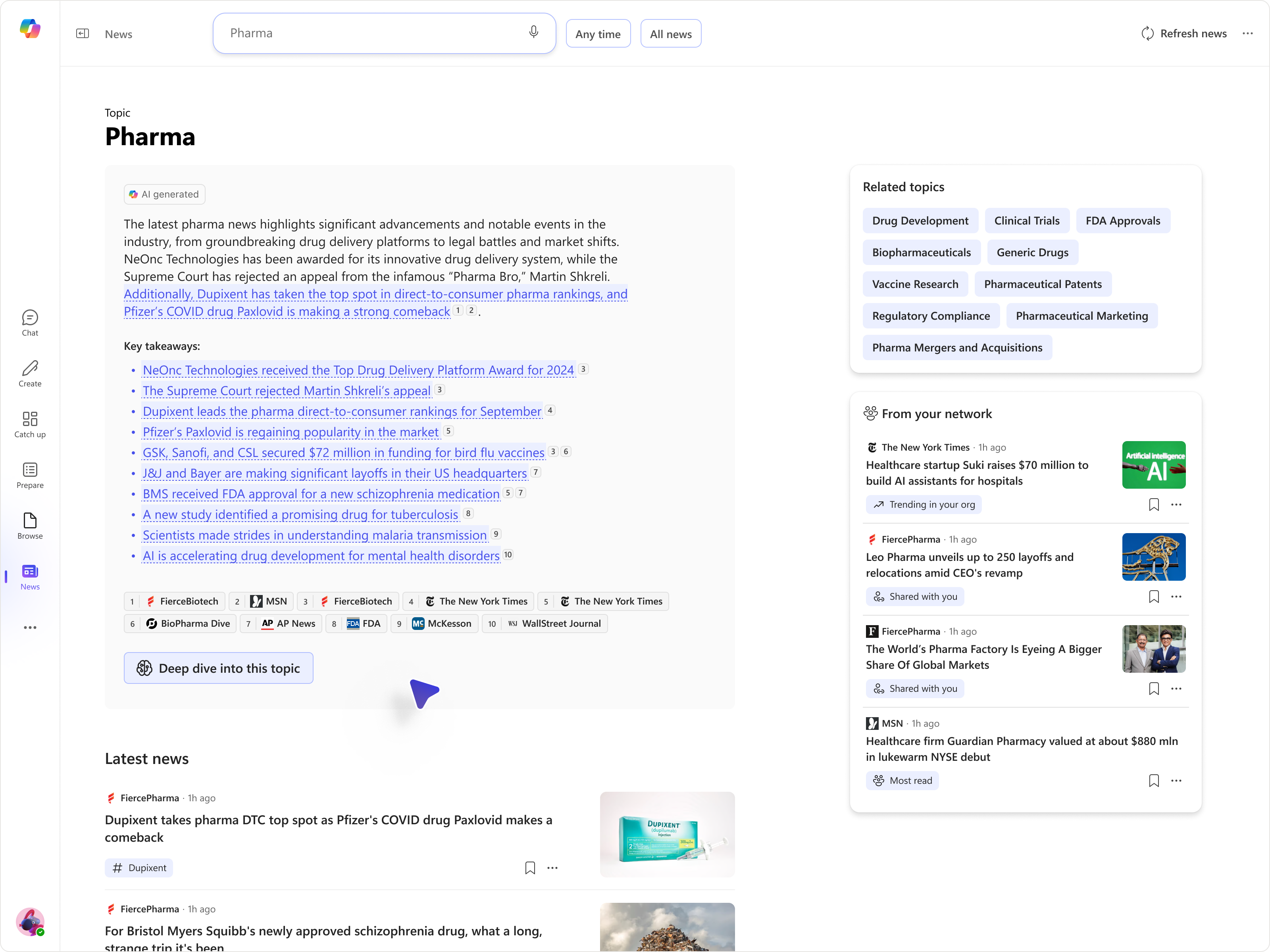
A year earlier I was the lead design manager for News in Microsoft 365, with three designers reporting to me. Our first real AI bet was News Briefings and Deep Dives: LLM-generated pieces that took scattered stories and turned them into one readable, opinionated digest.
Briefings were short. Deep Dives were the long-form version, pulling from many sources, synthesizing, citing, and built to be read end to end.
Researcher didn't start as Researcher. It started as a briefing.
In hindsight, that was already the shape of a research report. So when leadership decided in late 2024 to build a deep research agent, they came to the team that had been doing it for news.
I was still running News. My Group Design Manager and I joined Researcher anyway, as individual contributors, and pushed hard to make the timeline real.
3.0
The challenges
The work itself
Four months was leadership's timeline, not a suggestion. The first weeks ran on near-daily reviews with the top of the company, where we showed our framing, our progress, and where we thought the product could go. To feed those reviews, my manager and I produced vision concepts on one-to-two-day cycles.
We adopted the Make to Think strategy. Instead of talking abstractly about what may or may not work, we built it, learned from live data and we progressively rolled out, cautiously, to see if we have Product Market Fit.
Defining the user flow
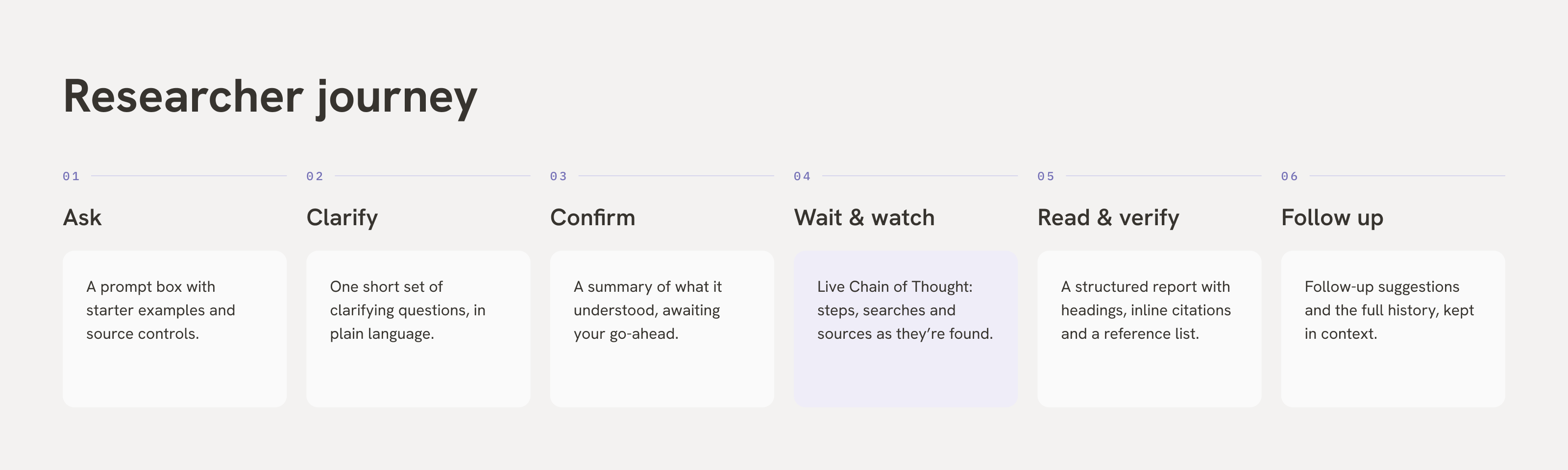
Copilot's flow was simple: user asks, model responds. Researcher couldn't work that way. A run could take ten minutes, sometimes thirty, and if the agent guessed your intent wrong you found out half an hour later.
We drew different approaches on the End to End journey so we can discuss the direction with the Senior Leadership Team. Then I prototyped it, and put it in front of research-heavy users in two rounds of interviews in March 2025. We wanted the whole thing to feel like a natural conversation rather than a wizard.
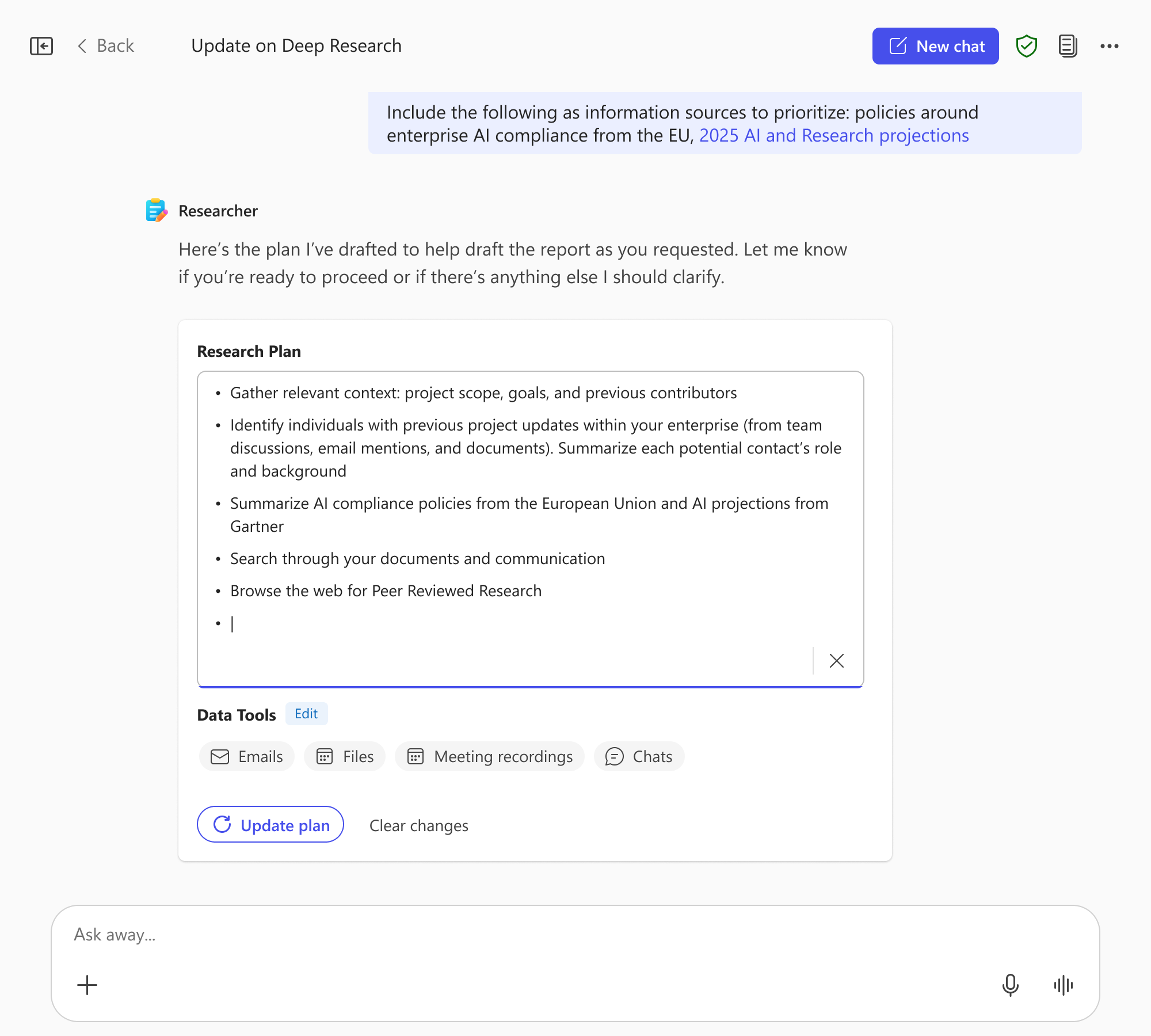
The planning phase
The hard question was how deterministic to make the step before research starts.
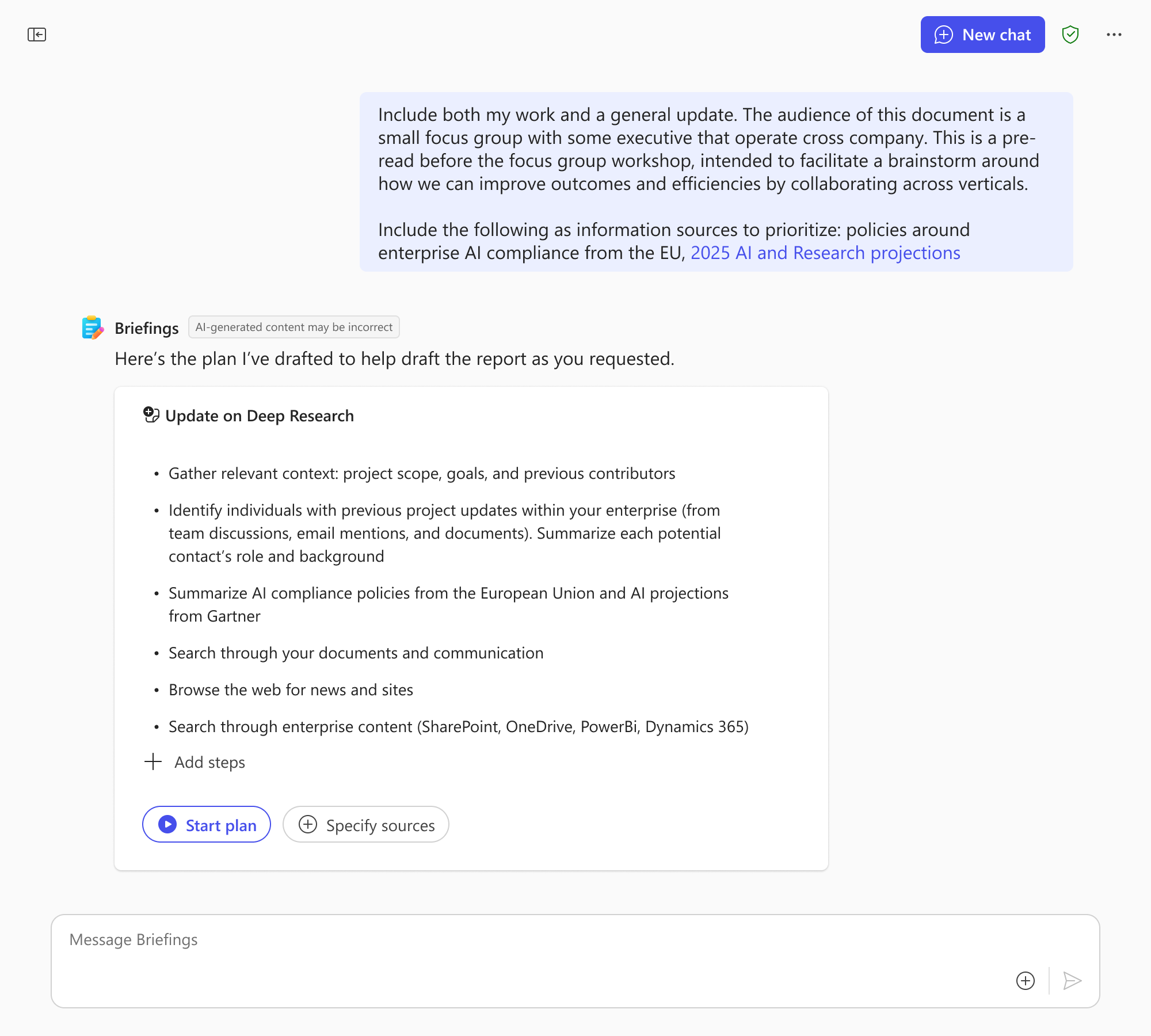
Some explorations pushed toward a highly customizable plan where you'd pick sources, edit steps, and tune the output. Testing exposed the risk quickly. Clarifying questions were valuable, but for casual queries the overhead of multiple steps might discourage user engagement. More options meant less starting.
My position was at the other end. Users should feel confident that prompting is enough, with no point-click-edit required to make the model behave. Have the agent state its assumptions and let people correct them in a sentence. One participant said:
"Assume what I want and let me say no if you're off. Then I don't have to do so much typing."
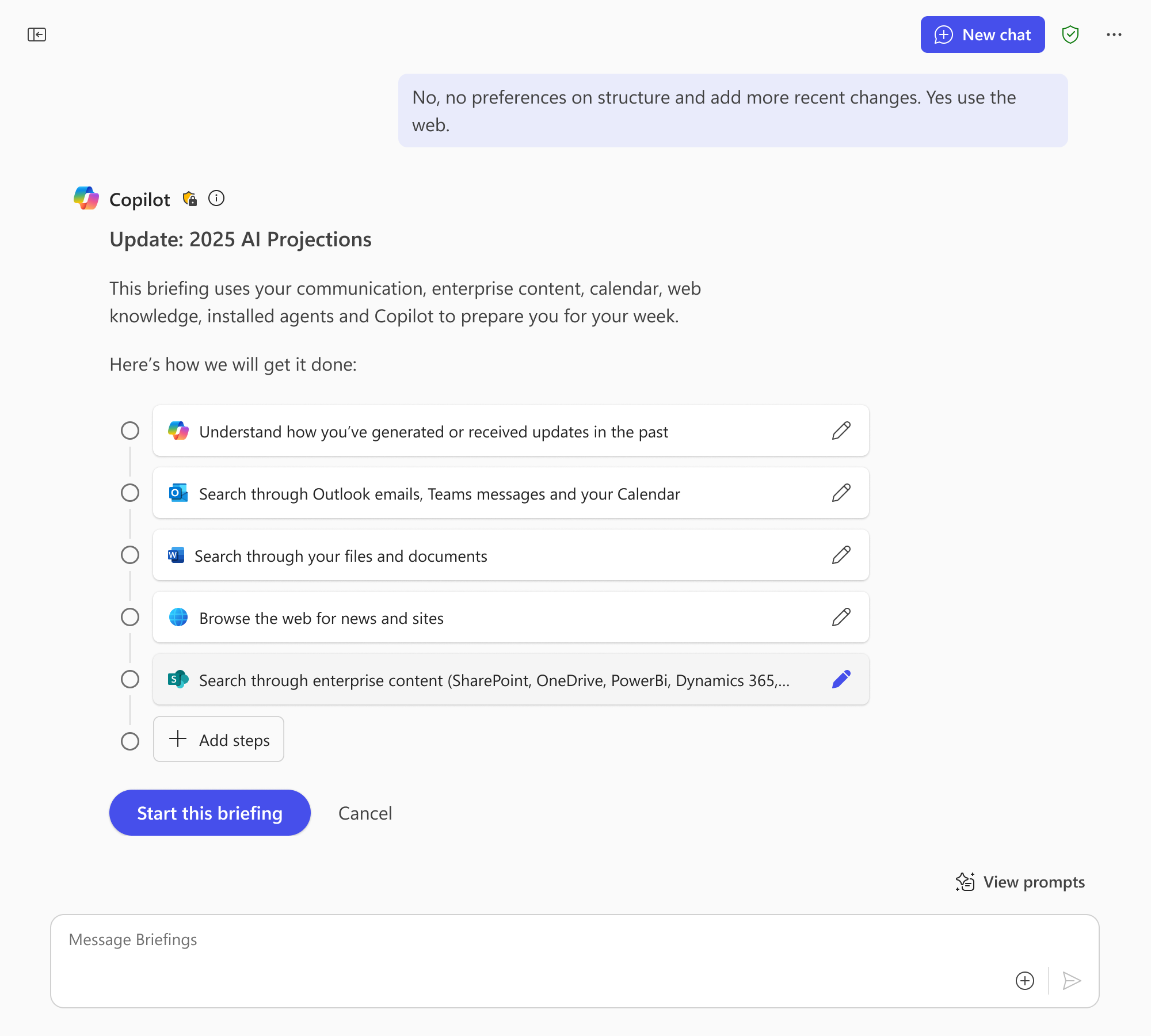
Given the clock, we landed on a clarifying-questions step, with sources requestable in the first prompt and files or sources addable at the clarifying step.
Engineering confirmed that re-rendering the plan mid-stream wasn't feasible for v1, so a typed reply became the refinement. Participants noticed: "Gemini and ChatGPT show you the actual plan and you can then go and edit something you don't like right there."
We shipped without it and put it on the roadmap.
Chain of Thought
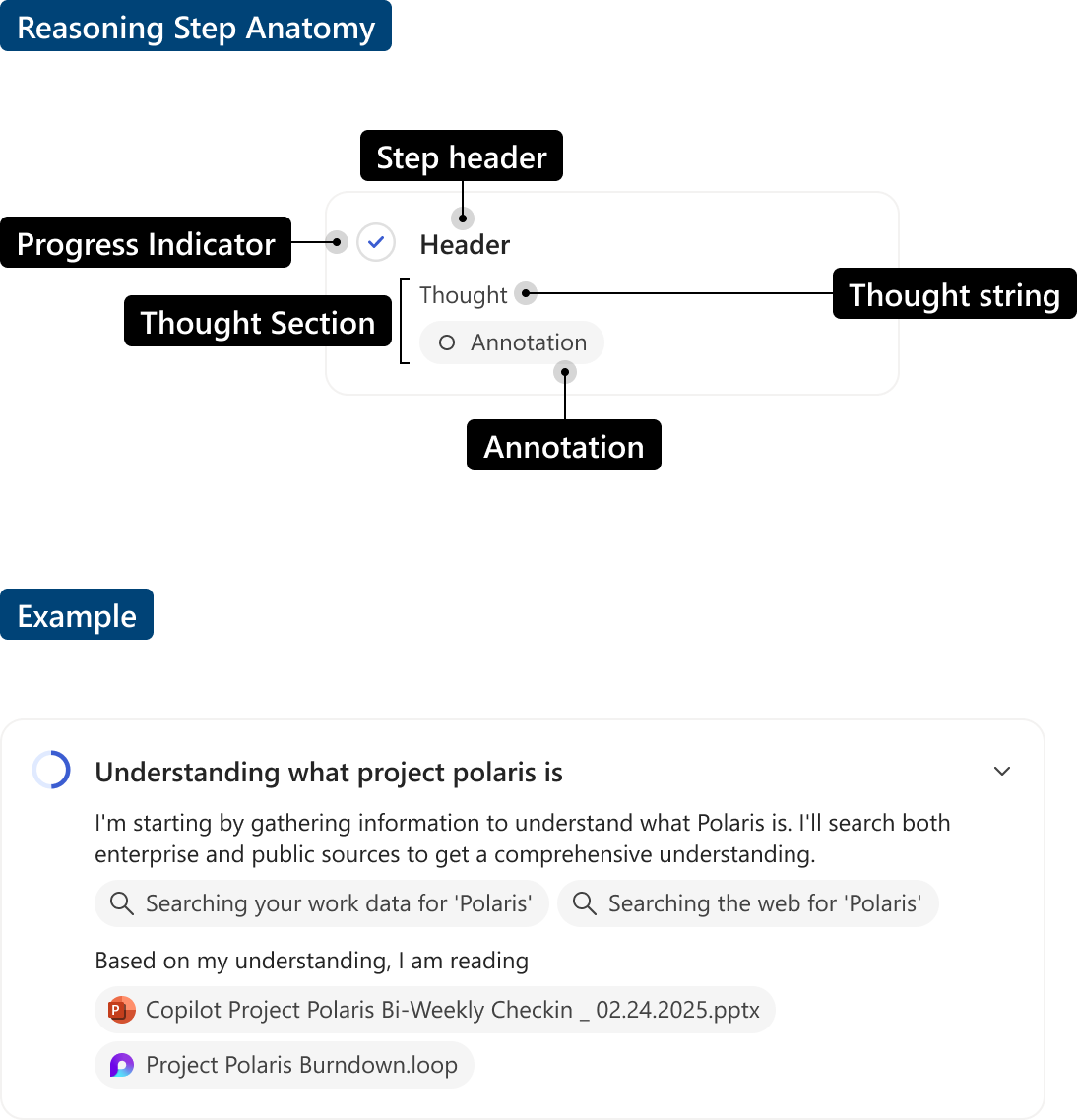
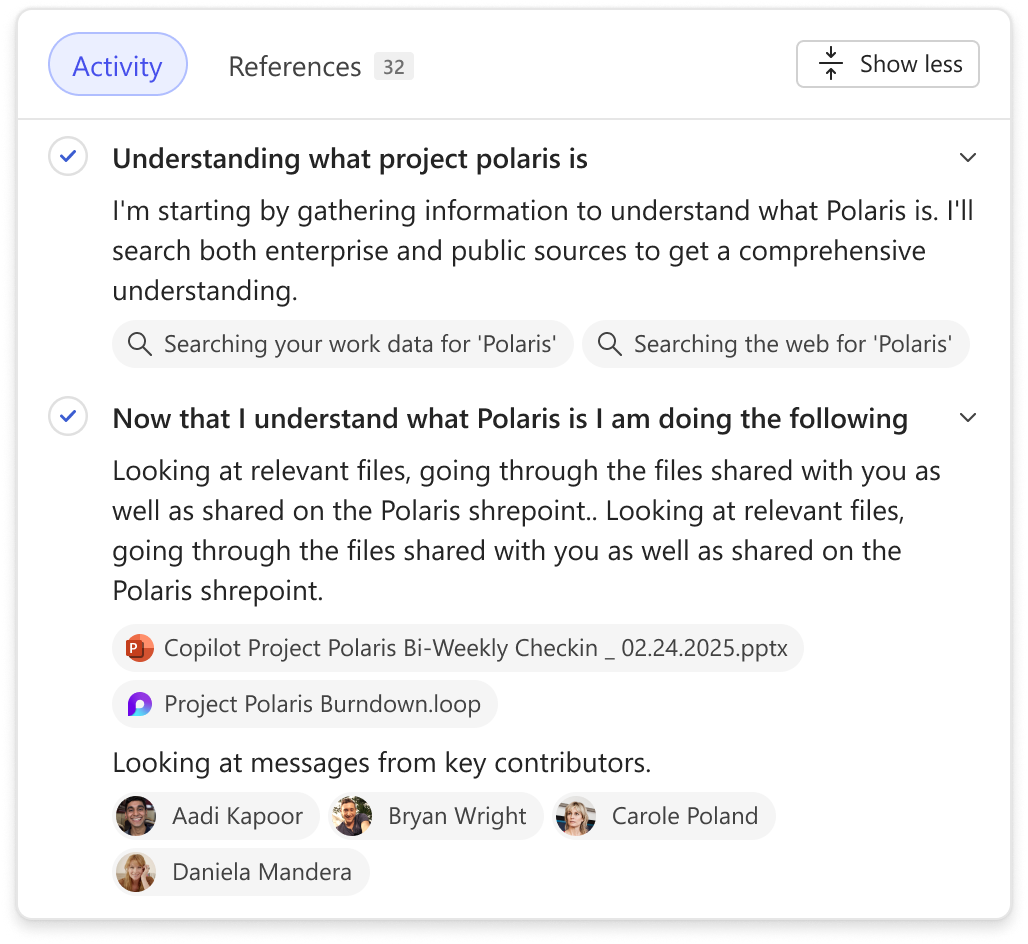
Chain of Thought is the agent showing its work while it runs: what it's reading, why, and what it found. For Researcher it was the hardest surface to design, because of how the system was built.
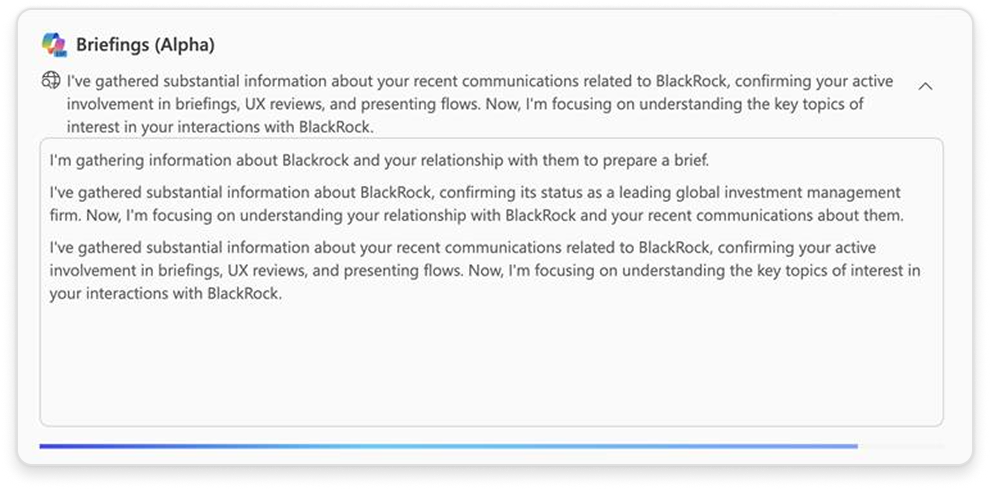
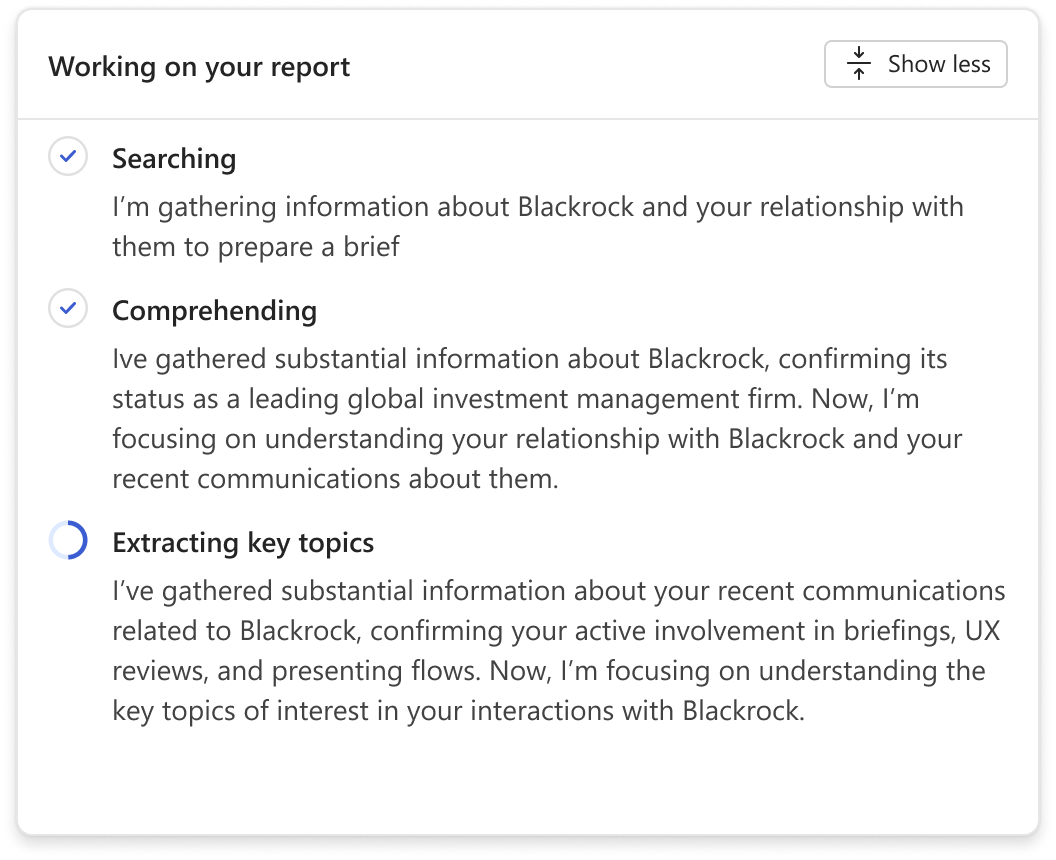
Researcher combined OpenAI's deep research model with Copilot's own orchestration layer on top. Two layers, two voices, and what came out was plain-text reasoning with no clear structure. My manager and I pushed to make that stream scannable in the time we had, with headers, grouping, visible sources, and a readable rhythm.
Trust was the recurring problem. The model would sometimes hallucinate a source or citation, and it bled into the final report. We kept returning to one question: how do we make references easy enough to inspect that people catch it? Users told us this was the whole game.
"The product could stand out by showing how it reasons with enterprise data. We can't just copy other solutions; we must highlight the internal sources."
Then came the debate with leadership over how prominent CoT should be. Expanded and front-and-center, or collapsed and discrete? The research cut both ways. Every participant said they’d look at CoT, especially early in using Researcher agent to build confidence. But in daily use they'd leave:
"It's just a feel-good thing to show me how many sources it's going through. I would go to another tab while this is running."
Rather than argue it in the abstract, my manager and I pushed a make-to-think approach: ship the expanded treatment, validate with real users, then decide. The question stayed live long after launch. A year later the platform team was still testing expanded against collapsed based on usage.
CoT Control v0.1
3/13: Frontier GA
5/19: Rocksteady GA
The report
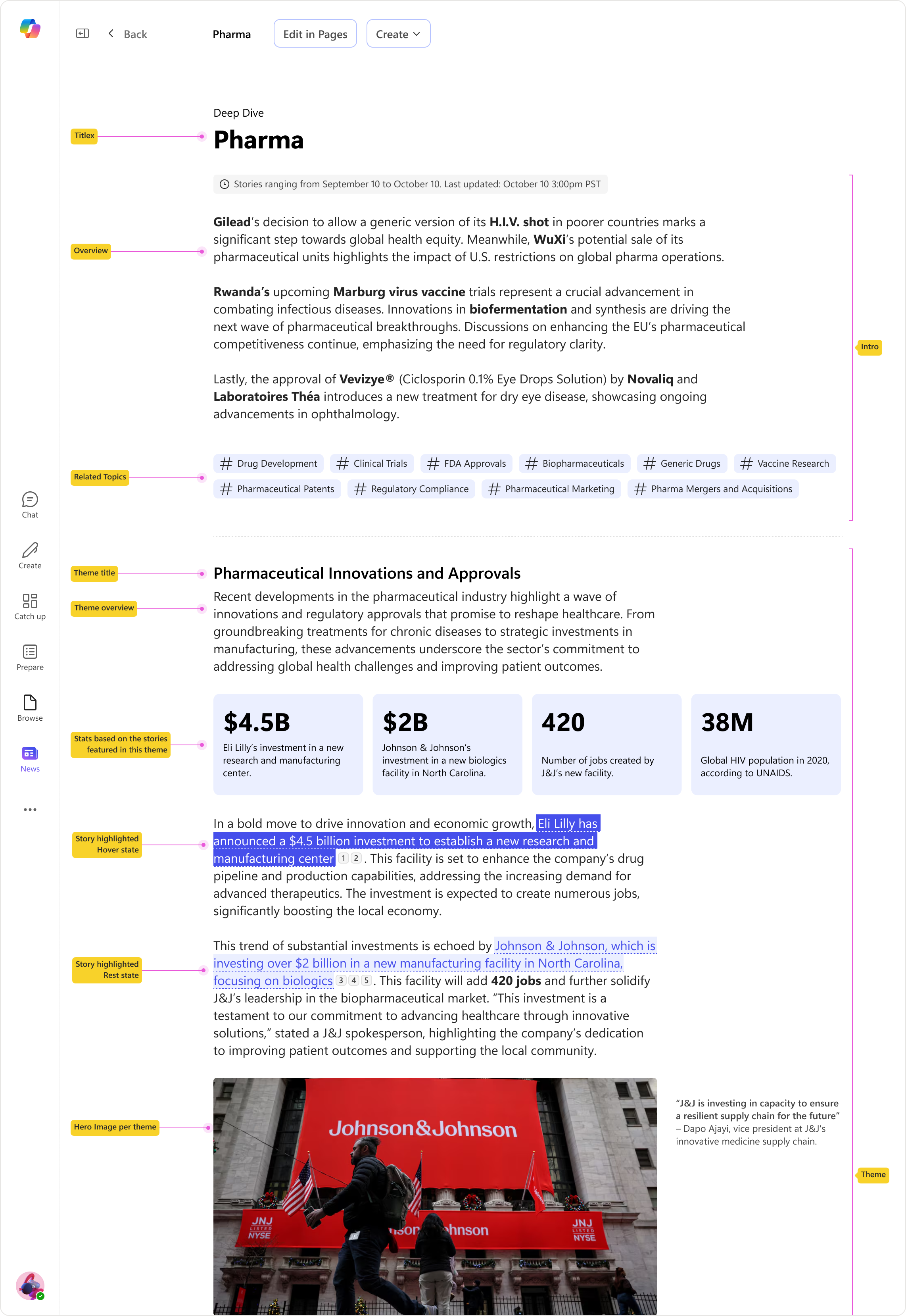
This is where the News work mattered most. For Deep Dives I had designed an editorial reading experience, with images, factoids, charts, pull quotes, and citations that made a long piece traceable and worth reading.
The team wanted to bring that to Researcher's report: The pitch to leadership in December 2024 described Deep Dives as reports you could customize with simple controls, share through Outlook and Teams, collaborate on in Pages, and refine by chatting with Copilot.
Unfortunately, the model behind Researcher was new, the orchestration was fragile, and every visual component was another thing that could render wrong or cite wrong. With a four-month runway to worldwide, I agreed to ship a text-only report and protected the parts that made Deep Dives work: a clear hierarchy of sections, a summary up top, and inline citations with a reference list at the end.
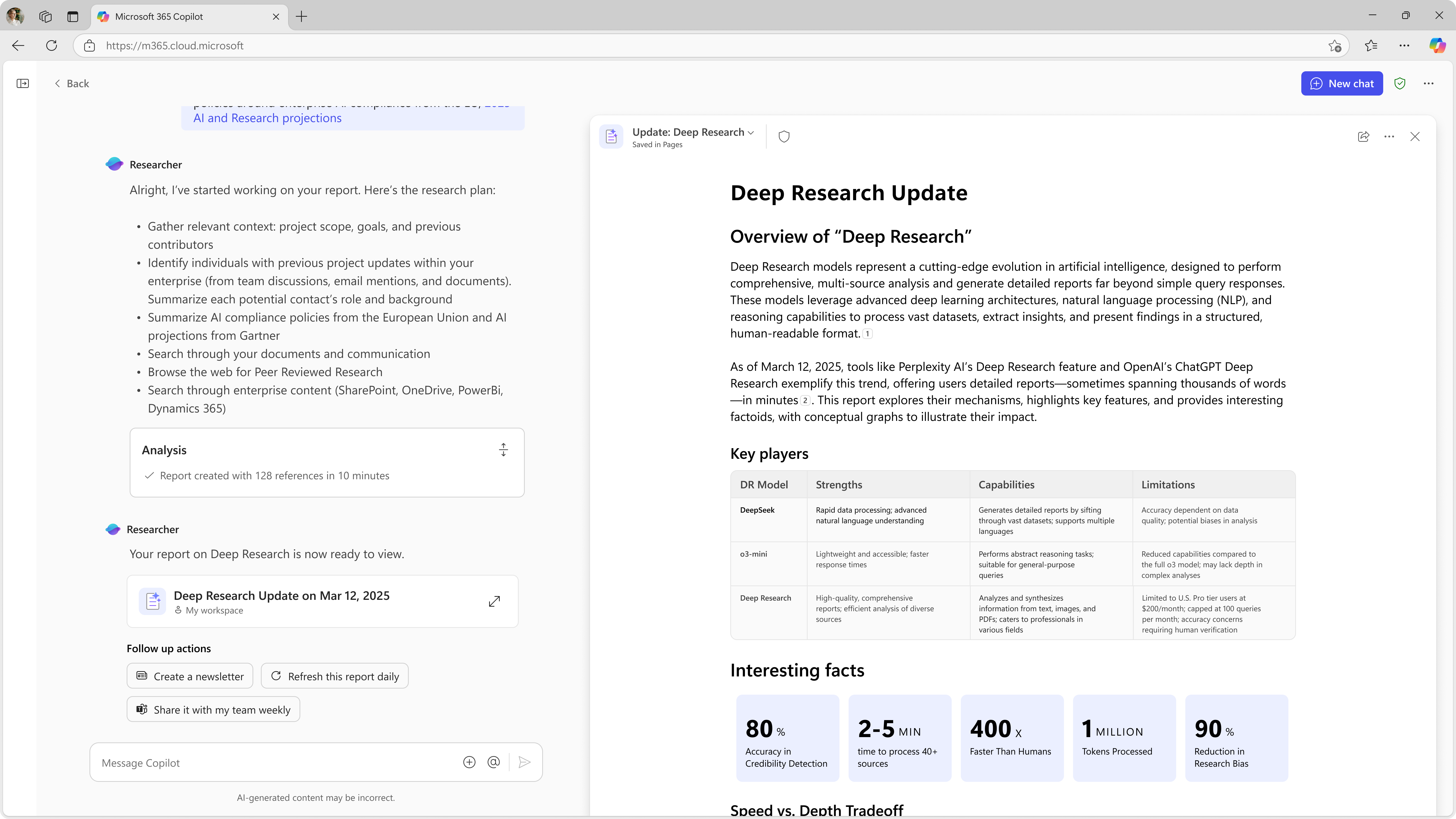
The frontier reports were just text: headings, bullets, tables, inline citations. Dense. Users flagged it before we shipped:
"Even a good report might be too long for me. I'll rewrite it in my voice."
Within weeks of launch, the team ran an experiment adding HTML components to the report. The containers were the Deep Dive toolkit under new names: metric cards for prominent numbers (the factoids), insight cards for key takeaways (the pull-quotes), and timeline cards for chronology. Each could carry its own citations. The report could also open in Pages for a fuller editorial view.
The side-by-side evaluation said the richer version improved visual structure and perceived presentation quality; raters preferred it more often than the text-only control, and the presentation score was the one dimension that moved significantly.
The launch
The whole design team was in it. We ran QA sessions and bug bashes, security and governance evaluations, side-by-side human feedback rounds, and a blind-testing program against competitors, alongside the marketing video and launch prototype. We aligned patterns with the Copilot core design team on citations, navigation, and the new app shell; worked with engineering on tuning and orchestration; and iterated with PMs the moment feedback hit Frontier.
The deal I made was simple: cut scope wherever needed to hit the date, then raise the bar after launch. A "what's next" investment list was drafted three weeks after announcement, and the GA checklist was running by the end of April.
4.0
The impact
The launch
Researcher was announced on March 25, 2025 as one of Microsoft 365 Copilot's first two reasoning agents, with a Microsoft blog post, a LinkedIn post from Satya Nadella, and press coverage noting that what set it apart was access to work data as well as the worldwide web. It reached all Microsoft 365 Copilot tenants worldwide in May and general availability in June.
At the top of the company.
Internally, we heard Researcher was being used to help close enterprise deals at the CEO level, and that it was described as the most exciting product the company was building.
A reference inside the org
Researcher became the studio's reference for long-running reasoning, and I became the person people pulled in. Colleagues tagged me for CoT reviews "since you have the most context," partner teams pointed to my files as "the latest designs we have from our designer," and when CoT had to be aligned across Researcher and other agents, I was one of four designers in the room.
Within days of the May launch, the studio formed a dedicated first-party agents design team with Researcher at its center.
Outside Microsoft.
Within weeks, Researcher was the most-used agent across first- and third-party agents. A how-to video on Researcher and Analyst passed 47K views, and analysts including Ben Thompson and Ethan Mollick were given early access.
Within days of the May launch, the studio formed a dedicated first-party agents design team with Researcher at its center.
From customers
The feedback was qualitative and consistent: more substantive than chat, better sourced, hours compressed into minutes. The gaps were the ones the research had predicted. Refining a report meant starting over, and sources occasionally didn't hold up. Those became the next year's roadmap.